

The purpose of art is...
/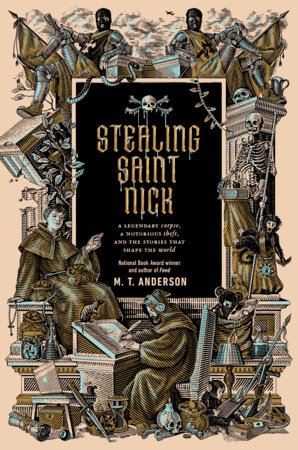
I’m reading Stealing Saint Nick by the inestimable M.T. Anderson. It’s a non-fiction book based on the research he did for his gonzo Nicked, in which the religious power structure in Bari, Italy, c. 1087 pay for a mercenary to take a young monk to Myra, Lycia, to steal the (775-year-old) remains of St. Nicholas. Why? To boost the tourist pilgrim visits to their small town.
He structures the book in an interesting way. First, he examines all the myths and legends that surrounded the Bishop of Myra and compares them to the very few facts we have about the actual man’s life. Then he goes over the facts of the 1087 heist, which don’t exactly match the hijinks in Nicked, of course, but which are still pretty outrageous. Finally, he shows how this humble yet miraculous medieval bishop became Santa Claus.
As he begins to examine the frankly unbelievable legends surrounding Nicholas (such as raising three boys from the dead after they’d been slaughtered by an innkeeper and his wife), he steps back and examines what these tales might mean to those who told them, how the stories might bolster their faith and/or self-concept as a people.
What stories and ideas help people? What gives them a better understanding of the world around them? What thrills them? What changes them? What opens new spiritual realities to them? What makes them feel connected to others around them? What explains the world to them? (p. 53)
Here he’s talking about how religions develop and how even the scarcely-believable legends get folded into the overall faith structure, but I was struck at how these questions could also apply to the fiction we create today. What values do we gain from reading Jane Austen, or Fyodor Dostoevsky, or Mo Willems? With whom do we sympathize in the story, and whom do we wish to see punished?
This is not to suggest that our fiction carries the same weight as religious legends, the purpose of which was to bolster the average believer’s faith and — quite frankly — to keep them in the literal fold. But on the whole, we as humans want to believe in fairness, kindness, selflessness, and we want to believe they will prevail over selfishness, cruelty, greed, and vindictiveness. We may be wrong, but we persist in thinking that if we cling to that one bright star, all will be well.
I’m also thinking that this tendency is innate, i.e., we’re born with it, much as we’re born with the urge to Make the Thing That Is Not, and I think I may have a way to test this hypothesis in an extremely unscientific way. As I complete the the universally-beloved BugVerse Chronicles and distribute copies, I’m going to ask people to send me photos of what their young person drew on the last page of each. My hypothesis is that young readers will draw a happy ending for Bug because this just makes sense to them. We want Bug to be happy. We want Elizabeth Bennet and Mr. Darcy to be happy. We want Frodo to be happy. We want Sauron doomed.
Stay tuned. (And of course, to take part in the experiment, go download A Bug’s Lunch to start with, share it a young reader, and then send me a photo of the last page.)
