

Uncovered: a series
/NOTE: If you are just here for the cat poetry, scroll down.
Yesterday I decided to do a bit of work in getting rid of some of the clutter in my study. Some of it, I said, so you can stop snickering.
As I posted on Bluesky yesterday, the best way to deal with being stuck in a creative project is to set about tidying up your space. You would be amazed at how many creative ideas your brain will come up with.
For example, I have an entire banker’s box full of old lesson plans, educational flotsam, from 35 years of teaching. There are some really good things in there, and we’ll get to them later, perhaps over at dalelyles.com where I used to blog about education issues all the time. (Here, here, and here. You will see some overlap in the categories.)
Today, I want to show off. Over 40 years ago I was media specialist at East Coweta High School, which at that time was still a very rural school with 800 students in grades 6–12. It was a good school. I had a small bulletin board outside the media center, and one of the displays I put out there was about poetry: different forms, strategies for writing, etc.
I discovered the elements of this display in one of the first folders I pulled up, and I was impressed, both at the pedagogy and the poetry.
For each poem, I posted neatly printed final versions alongside my original manuscript with scribbled notes in the margins to 1) provide hints on how to work; and 2) to show that the writing process was never straightforward. What struck me was that this was pure Lichtenbergianism more than 20 years before we even formed the Lichtenbergian Society! Of course, as I say at the outset in the book, none of it is new — it’s just the way that MAKING THE THING THAT IS NOT works.
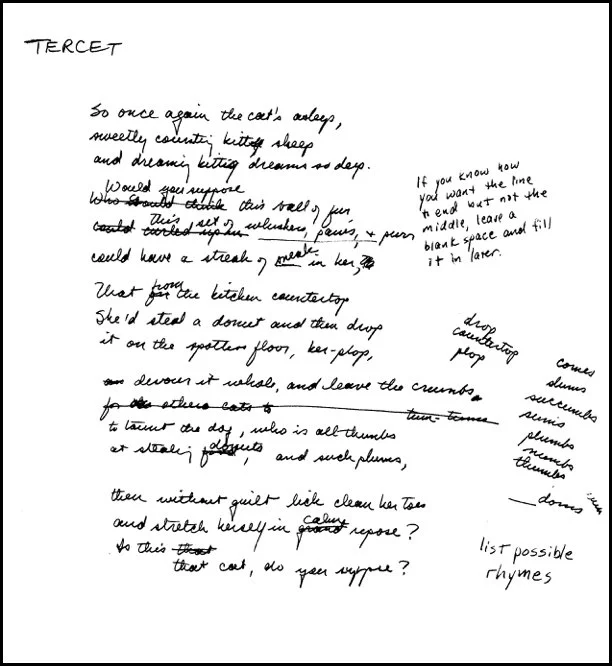
Here are the poems. (This is the showing off part.)
Terza rima is Italian for “third rhyme” and is the open-ended form used by Dante in his Divine Comedy. Each stanza is three lines. The “outside” lines — first and third —rhyme, and then the middle line becomes the outside rhyme for the next stanza, creating an interlocking thread. The rhyme scheme is aba bcb cdc ded, etc., although you will notice the use of slant rhyme here. The meter for this example is vaguely anapestic tetrameter, i.e., four beats of - - /
Cats Sitting
Like stones in a Japanese garden they sit,
obtuse and opaque, without reference to time,
controlling the universe, silently. It
looks like they wrap the room's vacuum around them to frame
their being and essence. The others
not fighting, just sitting and doing the same,
weave a conflict of vectors, a network of eithers,
of boths and of neithers, a webbing of space
which ties the world down just as each cat prefers.
One stretches and moves. The cosmos has changed
to accommodate this one's perspective. The cats
are changing your fate with the planets they face.
Blank verse is your basic English go-to that you remember from Shakespeare: iambic pentameter. The - / pattern is natural to English, and five of those “beats” are about the length of an English thought pattern. (French goes one more beat for the ‘Alexandrine’ line.) It does not rhyme.
Blank Verse
There is a cat, and there, and there. Where is
the point of all these omnipresent cats?
Why should my house be littered with these beasts
of fur? Why should I tolerate this cat
asleep atop a piece of work I must,
must, positively put my hands on next?
Yet there's the cat, asleep, or worse, awake,
aspiring through hypnosis with her purr
to charm me into some confession that
she belongs exactly here, asprawl
the very words which up until a little
moment ago I thought were necessary
that I read. Not now. Not ever. She's
enthralled me; I'm her slave and do her will.
Yes, extra food is in the cupboard, dear.
I will go and get it for you now.
Free verse has no rules. See: Walt Whitman
Free verse
Each has a voice:
Miranda's squeak; tough-boy Bentley's bark;
and Darcy's irritating apologetic squeal:
"I'm sorry I want out oh is it three in the morning I didn't know"
Be a man, Darcy, you weigh twenty pounds,
wait until daylight, why don't you?
"I'm sure I'm starving" screams Miranda.
She's not assuaged by references to time.
"Pay attention now" chops out the B-cat,
and flops over his ears to expose his belly for petting.
And patiently sitting on his bench outside
Pomfrey stares in and wonders if he's too afraid to be a pet.
He greets me with his hopeful chirps of fear.
Triolet is a verse form, generally iambic, with the rhyme scheme ABaAabAB, where the capital letters represent lines that are repeated verbatim. The trick is to structure those lines so that the syntax provides a slightly different meaning each time depending on the context.
Triolet
I write this poem for the cat
who sits and watches me
scratch the paper. Watch how fast
I write this poem, for the cat
will soon demand i scratch her head
instead, so hurriedly
I write this poem for the cat
who sits and watches me.
Tercet is simply stanzas of three lines each, with each group of three lines having the same rhyme, i.e., aaa bbb ccc etc.
Tercet
So once again the cat's asleep,
sweetly counting kitty sheep
and
dreaming kitty dreams so deep.
Would you suppose this ball of fur,
this set of whiskers, paws, and purr,
could have a streak of sneak in her,
that from the kitchen countertop
she'd steal a donut and then drop
it on the spotless floor, kerplop,
devour it whole, and leave the crumbs
to taunt the dog, who is all thumbs
at stealing donuts and such plums,
then without guilt lick clean her toes
and stretch herself in calm repose?
Is this that cat, do you suppose?
One more thing: Around that time I was moonlighting as a writer with Turner Educational Services, which meant that I’d go in to CNN Center in Atlanta and create lesson plans/handouts for Turner’s Cable in the Classroom initiative. (Another great group of people!) Here’s a handout that I was able to create straight from my bulletin board.
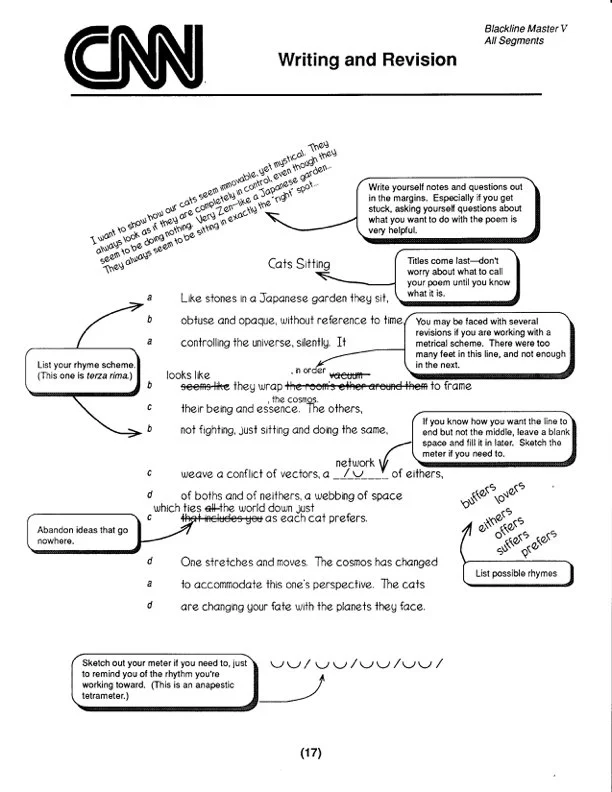
This would easily fit into either Lichtenbergianism: procrastination as a creative strategy or A Young Person’s Guide to Lichtenbergianism, wouldn’t it?
One further lesson: After I posted this and then circled back to edit the post (GESTALT and all that), I noticed a glitch in one of the poems and actually edited a line forty years after I wrote the thing.
