

Lessons from A Bug's Dream
/After last week’s posting of A Bug’s Nap, I was encouraged by its completion to push ahead with the next book in the universally-beloved, award-winning** children’s series the BugVerse Chronicles: A Bug’s Dream.

Let’s review the process that I used to get to that ABANDONMENT, shall we, and examine how it’s a great example of the ABORTIVE ATTEMPTS >> GESTALT >> SUCCESSIVE APPROXIMATION cycle.
As a side-benefit, we can also get a glimpse at the premise behind that new book that I’ve been promising since last year, The Beethoven Blueprint. (It is technically one of my Proposed Efforts for this year.)
When I started on this project there was only the first book, A Bug’s Lunch, but the character of Bug lured me into further adventures and the BugVerse was born. As I’ve posted before, it began with scribbles in my WASTE BOOK:
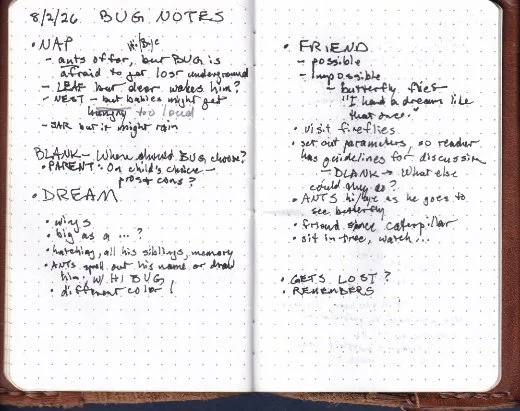
There are already ABORTIVE ATTEMPTS/GESTALT thingies to observe. Under DREAM, for example, the bullet point of “hatchling, all his siblings, memory” almost immediately triggered the fifth book, A Bug’s Memory.
In any case, this is the first phase of the Beethoven Blueprint: Scribble those ideas down in your WASTE BOOK as soon as they occur to you. As the motto of Field Notes Brand assures us, “I am not writing it down to remember later, I’m writing it down to remember it now.”
(Beethoven carried a notebook with him on his daily walks, mostly for others to write down their side of the conversation for him to read after he became deaf in his 20s, but also to write down the musical ideas that came to him. [This is actually a perfect example of TASK AVOIDANCE as well: get up, get out, go for a walk — and take that WASTE BOOK with you.])
Phase two of the Beethoven Blueprint is to transfer those ideas to a workable but not definitive space. In other words, you’re still thrashing through the ABORTIVE ATTEMPTS stage, which in my case was a couple pieces of paper folded and cut to give me my sixteen pages. This gives me the chance of playing with those scribbled ideas and seeing how best to deploy/enlarge them.
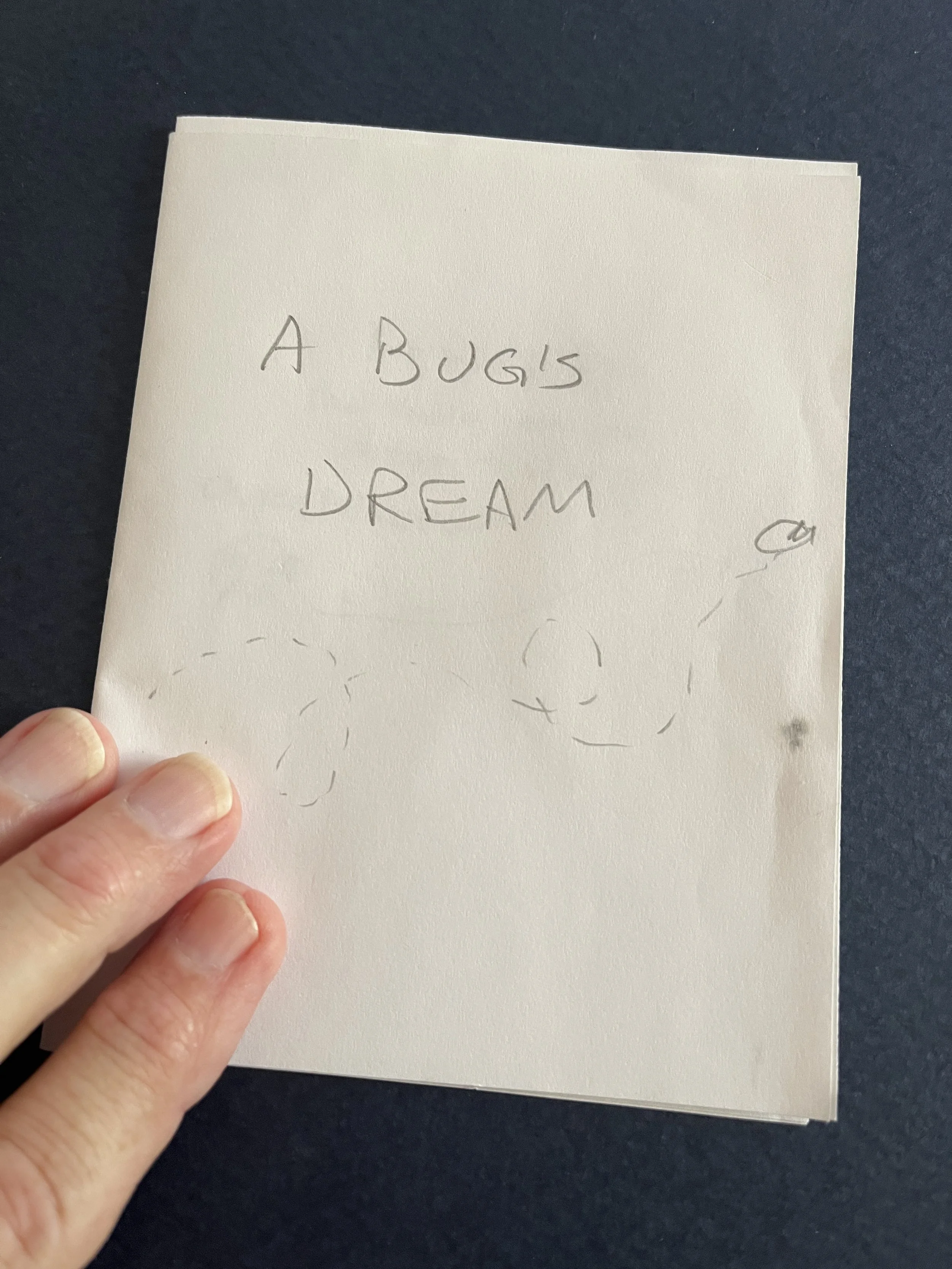
Here’s where we run smack into the King of Hearts Fallacy like a brick wall. No, not even in something as simple as the fourteen actual pages of a Bug book was I able to “start at the beginning, go until I reach the end, then stop.”
The ideas I had already written in my WASTE BOOK were easy…
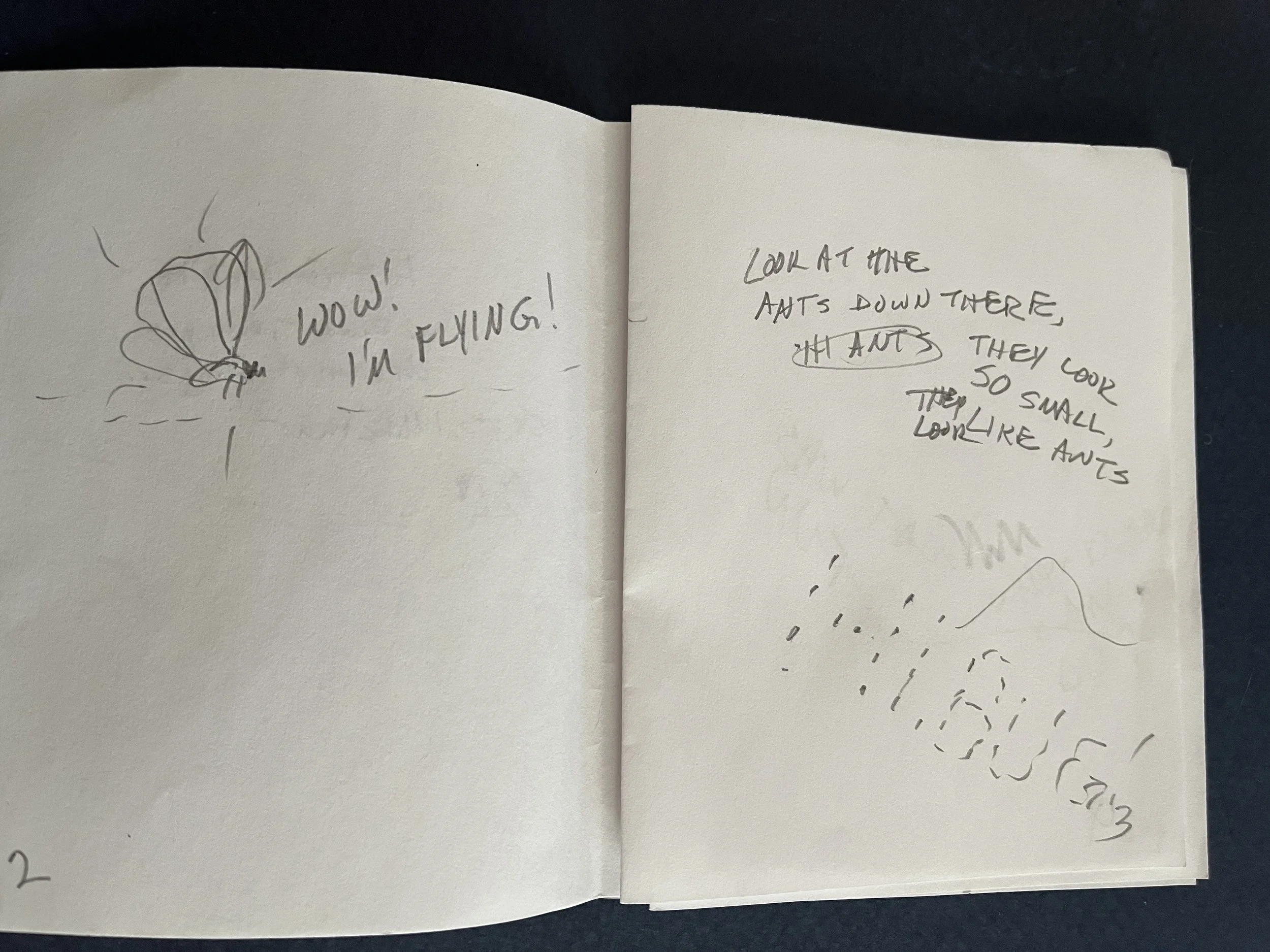
…but unlike Lunch or Nap, I hadn’t really had enough ideas to make the book work. Pages like this kept clogging up the process…
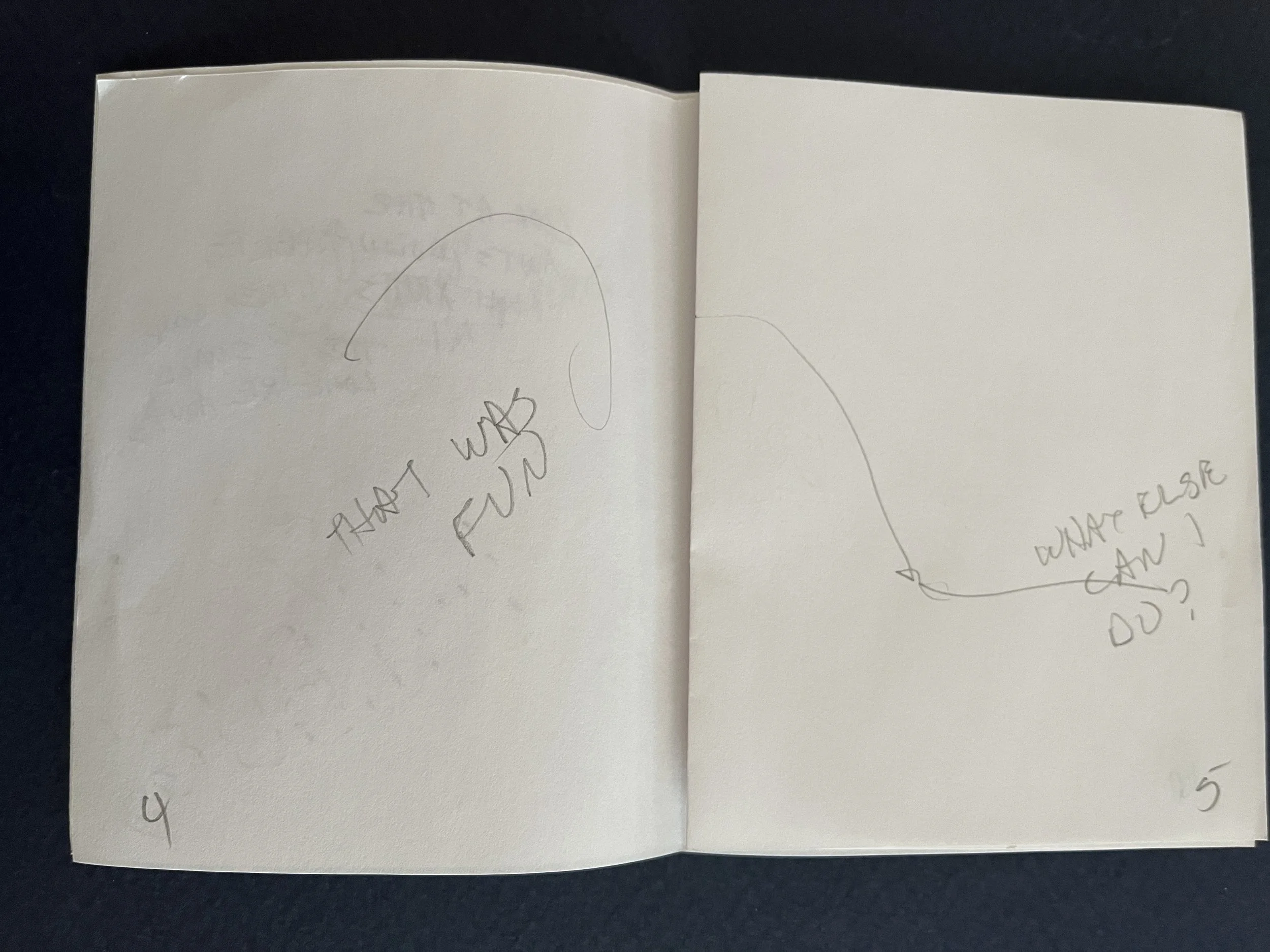
…because they didn’t really have Bug doing anything.
So in this second phase I take my scribbled shinyperfects and begin to hammer out what other dreams Bug might enjoy.
(Once he returned from his walk, Beethoven would go over his scribbled ideas and start tinkering with them to see what they might be developed into. If a theme showed promise, he would start a second notebook to start playing with that theme, adding to it, expanding it, etc.
(Then when he was happy with the direction a piece was taking, once he decided, ‘oh yeah, this is going to make a killer cello sonata,’ Beethoven would take a new, third notebook and actually compose the piece, which readers of Lichtenbergianism will remember was still an incredibly messy process.)
Full disclosure: I did not finish designing/planning Dream before I transferred the project into the third phase, i.e., using the layout program Affinity to begin creating the book. I could have stuck it out in my phase two prototype, sketching in pencil and brainstorming there — or I could shifted back and forth between Affinity and paper until I was satisfied. Either would have worked.
As it happened, working in the layout program alone was successful. Eventually I came up with the following line-up of sub-dreams:
Intro
Flying/Ants
Falling/Ice cream
Singing
Bigger (big ‘sorry’)
Colors
Next
But that progression bothered me. I wanted the “singing” dream to be the center of the book so that when printed it got its own whole piece of legal-sized paper for its spread.
(Other spreads, when printed front and back, have to rely on aligning Bug’s path from one half-page to its corresponding half-page elsewhere in the layout. When the Chronicles are picked up by a publisher and printed as board books, each spread will be one piece of paper, so that layout thing won’t be an issue.)
So I began the whole GESTALT >> SUCCESSIVE APPROXIMATION thing. What was missing? For me, it was a sense of flow from one dream to the next. I thought putting the “colors” dream right next to the “next” page, where Bug appears in all the colors, was a bit much — I liked the idea of the colors showing up again after we’ve moved on to another dream.
I tried again:
Intro
Flying/Ants
Singing
Colors
Falling/Ice cream
Bigger (big ‘sorry’)
Next
This process was actually far easier than you might imagine, since in Affinity you can bring up the entire document in a sidebar of page thumbnails and just drag pages/spreads where you want them — and the page numbers change automatically!
Now “bigger” bothered me. The problem was that the drawing of Bug leaving the scene, still “bigger,” felt like was too abrupt a transition when it led to Bug’s normal size on the next page. I solved that by having Bug shrink back down while apologizing, but still the sequence of dreams didn’t work for me. (This version also put “colors” in the centerfold.)
Intro
Flying/Ants
Colors
Singing
Bigger (little ‘sorry’)
Falling/Ice cream
Next
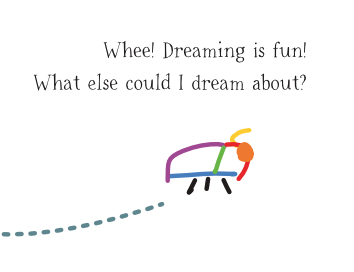
And this one worked. “Colors” appears early enough to set up the “next” illustration, and “bigger” segues neatly into “falling” — I may change Bug’s “Oh dear” into “This is kind of fun” or something more positive, but that’s between me and my publisher I’m sure.
With that, A Bug’s Dream is ready for ABANDONMENT. Go check it out.
NEXT UP: A Bug’s Friend!
ALSO: To summarize, Beethoven’s Blueprint is simply starting with a simple idea, experimenting with that idea through whatever ABORTIVE ATTEMPTS you care to play with, and then moving into a final phase or setting where you build on those ABORTIVE ATTEMPTS through GESTALT and SUCCESSIVE APPROXIMATION: WASTE BOOK, prototype, production.
** So if you have an award you’d like to award the BugVerse Chronicles, better get on that before it becomes cliché.
