

Favorite Things
/I came across a cool website/email a while back called Sketchplanations, and in this recent post Jono Hey talks about a podcast on which he was a guest, and the host asked him to name his five favorite creative works.
I know a challenge when I see one. It is not an easy one, at all, and I will most definitely cheat.
Also too, this post is inordinately long.
My 5 favorite creative works, a list
Mahler, Symphony No. 2, “Resurrection”
This is almost always the first musical work that comes to mind when I think about my favorites. That is quite the recommendation, given that I have over 1,600 albums on my laptop, most of which are symphonic in one way or another.
Gustav Mahler’s music was in his day either a sensation or a puzzlement. Since the middle of the 20th century, however, his symphonies and other works have become standard even as they have retained their ability to awe us. His Symphony No. 2 is gargantuan: a huge orchestra, soloists and huge chorus, and the text of Klopstock’s poem “Resurrection.”
The result is stunning. The whole work is an hour and a half long, and the attached video of Leonard Bernstein conducting the London Symphony Orchestra is a great rendition. The video starts at the final five minutes, with the following text (in German, naturally):
O Pain, you piercer of all things,
From you, I have been wrested!
O Death, you conqueror of all things,
Now, are you conquered!
With wings which I have won for myself,
In love's fierce striving,
I shall soar upwards
To the light which no eye has penetrated!
I shall die in order to live.
Rise again, yes, rise again,
Will you, my heart, in an instant!
What you have beat,
To God shall it carry you!
Here’s a free score, if you’d like to follow along. Where the bit in the video starts is on page 197.
The Complete Works of William Shakespeare
Here’s the thing: Out of Bill’s 39 plays, I have directed ten. (Three times for Midsummer.) They are inexhaustible treasures. Whenever anyone tells me they never “got” Shakespeare, I offer them condolences for having a crappy English teacher who taught it as literature instead of theatre. These texts are plays, the popular entertainment of their day, and they absolutely still work.
Remember, I was directing these plays with complete amateurs — most of whom had never “done” Shakespeare, and some of whom went on to become professionals, thank you — and we pulled it off every time. For at least two productions, professional actors drove down from Atlanta to join us, so there’s that.
My point is that Shakespeare is not some impenetrable mystery, some sacred relic. It’s theatre, and while the language may take a little work, remember what I told my casts as we began rehearsals: Those words are not a stumbling block; they are your tools!
(I’ve told this story repeatedly, so skip this paragraph if you’ve heard it before: After one performance of Much Ado, one gentleman was overheard leaving the performance space saying, “That was really funny! Who wrote it?” Shakespeare is not a sacred relic.)
The Tao Te Ching
The classic Chinese treatise on governing, both of a nation and of one’s self. It has been my go-to text for guidance forever, particularly the Stephen Mitchell translation/adaptation. My favorite verse is the end of 17:
The Master doesn’t talk, he acts.
When his work is done,
the people say, “Amazing:
we did it, all by ourselves!”
It’s a lesson I remind myself of a lot.
Switched-On Bach
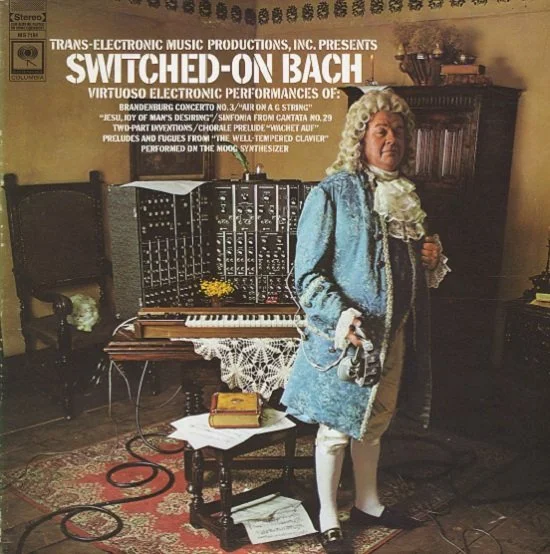
That opening ‘Sinfonia’ still blows me away.
I have mentioned Wendy Carlos’s Well-Tempered Synthesizer in passing over on my other website, but it was her first album, Switched-On Bach, that completely turned my life upside down. I have a vivid memory of going to a fellow Key Club member’s house for some kind of meeting — it may have been a Christmas party — and one of the guys had brought his cassette tape to share with us. I was electrified: The brio of the synthesized orchestration + the absolute brilliance of Johann Sebastian Bach, what a mindblower!
It led me deeper into classical music, so much so that to this day I have no real experience of the popular music of the 1970s/80s/90s. Instead, I immersed myself in Bach, in Beethoven, Mozart, Mahler, all the greats. (That’s an admission of a shortcoming, not a brag, actually.) When a family relative recently marveled at how I was able to compose without any academic training, I simply pointed out to her how much I had paid attention to the greats — and then STOLE FROM THE BEST.
any dance music before 1950 (definitely a cheat)
You may not know this about me, but I can teach you a great many social dances from 1500–1940. I have a whole shelf of CDs of period dance music. I have taught hundreds of people — well, GHP students, if they count — how to waltz, polka, tango, country dance, pavane, galliard, minuet, and many, many more!
So yes, I have to include “dance music” [unspec.] as one of my five favorite creative things.
Runners-up: the Discworld novels of Terry Pratchett; Beethoven’s Symphony No. 9, “Choral”; The Lord of the Rings; the Pals in Peril series by M. T. Anderson; Gilbert & Sullivan’s Pirates of Penzance, any version, it’s a romp.
NEXT WEEK: My five favorite creative works of mine! (Feel free to guess in the comments what they might be.)
