

Pro tip: It's a comedy.
/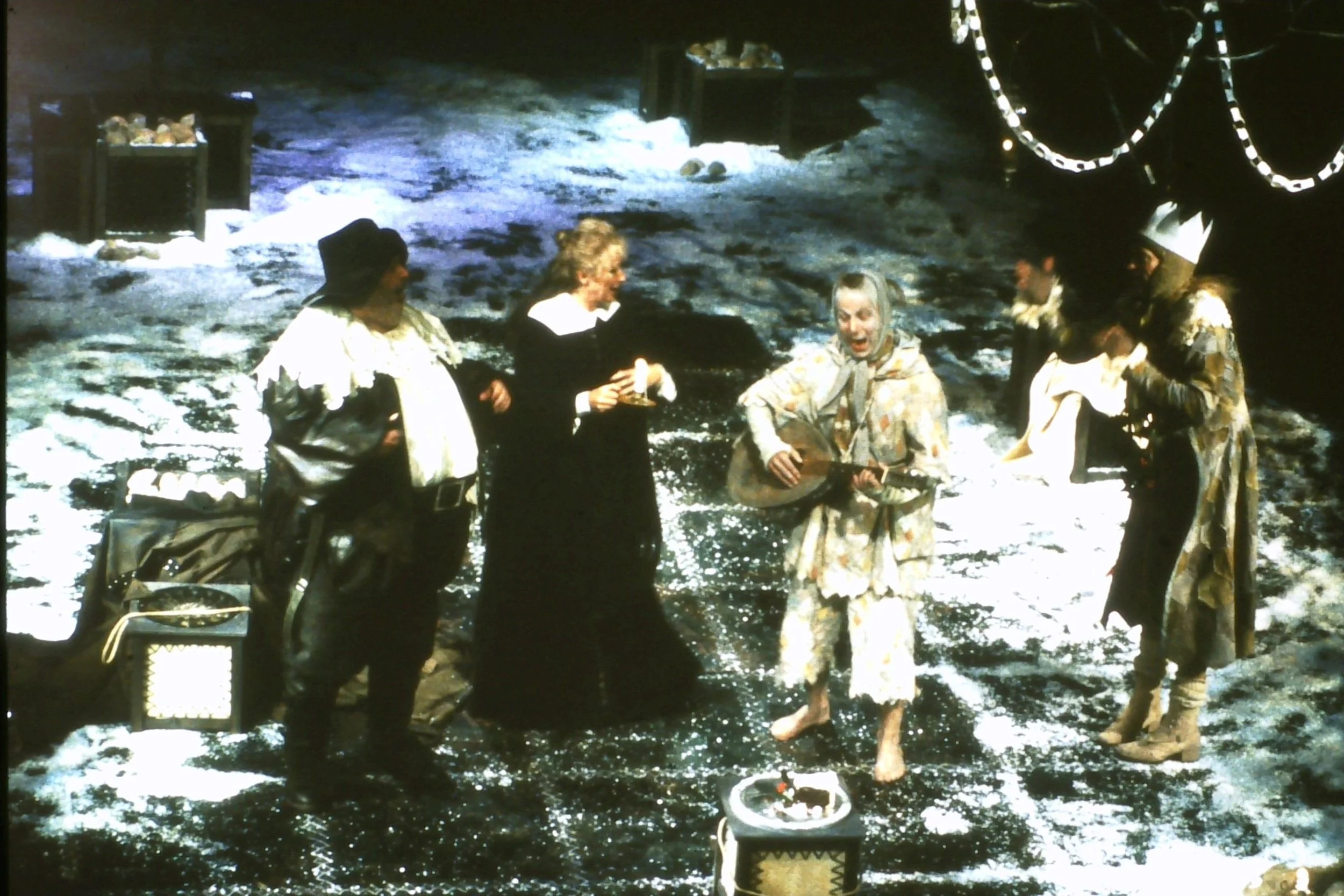
RSC Twelfth Night 1979. Willoughby Goddard as Sir Toby, David Bradley as as Sir Andrew, Bruce Alexander as Feste, Pippa Guard as Maria
Decades ago, my Lovely First Wife and I saw two productions of Twelfth Night fairly close to one another, one at the Alliance Theatre in Atlanta, the other at the Royal Shakespeare Company’s theatre in Stratford. Both were marked by a distinctly melancholy, autumnal feel, and it bothered me.
It bothered me so much that I decided I would direct the show with my gang at Newnan Community Theatre Company and it would be as bright and as funny as the script actually was. We would not be watching Malvolio snarl his impotent curses at the rest of the cast and stalk offstage, leaving them to worry whether they were the baddies. Nope: Malvolio deserved what was coming to him, and the children were right to laugh at him.
We set the show at the beach in Illyria, everyone wearing hand-dyed cotton summer wear (except for that Puritan Malvolio), and the audiences loved it. My favorite comment, overheard as the audience was leaving: “That was really funny. Who wrote it?”
Last night, we saw The Marriage of Figaro, and I regret to report that the Malvolio Virus is still out there. Enormous gothic gray walls, encrusted with stucco and portrait medallions, moved and rotated from scene to scene, dwarfing the residents of the palazzo. A single four-poster bed went from scene to scene to scene until I guess the director couldn’t figure out a way to wedge it into the garden of Act IV, and in any case the garden was more of a refuse pile of broken furniture and trash than a garden. (I supposed I should be grateful the bed didn’t end up on the trash heap.)
The supertitles were prosaic and didn’t make us laugh. (One egregious error was that whoever was in charge of keeping the supertitles aligned with the action was asleep at the wheel and completely missed the one actual joke in the libretto: Figaro claims that the gardener Antonio couldn’t have seen the page boy Cherubino jump from the Countess’s bedroom window because the boy was (supposedly) on horseback on the way to Seville — and the drunken Antonio counterclaims that he saw no horse make the jump.)
The motif that bugged me the most, though, was that whenever any character sang about their worries or their fears, all the lighting went to gray and the singers were hit by dead white underlighting. Such Europe, much emo.
That’s not what this show is about, people.
Yes, they’re worried or afraid: they’re all involved in some pretty shady business that will shortly collapse around them with hysterical results. It’s part of the setup for the hilarity that ensues, not an opportunity to show us how “human” these characters are.
Because when the moping was over and lighting returned to the comedy, our characters were still having to hide from each other, lie about one thing or another, and conceal inconvenient evidence. In other words, they were in a farce, and trying to make us feel for them derailed the action. It’s a silly move. We love these characters anyway, we’re rooting for them to get through the day, and we rejoice in the improbably happy ending. Ditch the emo. It does not illuminate the show.
There’s one key moment in Act III when Figaro discovers that old Marcellina — to whom he owes 2000 crowns and must marry if he can’t repay her — is actually his mother, and Doctor Bartolo is his father. It’s ridiculous, plotspeakingwise, and my directorial instinct is that Mozart (and playwright Beaumarchais before him) was sending up the similar ridiculous plot reversals in the popular entertainment of the time. Just listen to the music: It switches from slightly ridiculous courtroom drama to over-the-top gemütlichkeit in a heartbeat. The laughs come from everybody in the room just rolling with it. You were going to have to marry that old woman and have sex with her, but now she’s your mom? What’s not to like? They’re one big happy family now.
Our production last night had Figaro be skeeved out by the idea — and continue to be skeeved out. I found it to be icky and distracting.
One more quibble, and this is on the director, not the singers: Arias like Figaro’s Act I “Se vuol ballare” or the Count’s Act III “Hai già vinta la causa!” are not so much private musings as they are Shakespearean soliloquies, and as such the performer should deliver it straight to us in the audience. Make that eye contact with us. Sell it to us, don’t sing it to the desk.
Actually, one more quibble, and then I’ll wrap this up. There’s a horrible tendency in opera for the director and the actors to simply “park and bark,” i.e., just find your spot on the stage and stand there. Don’t move. Just sing.
It’s boring, guys. Ramp up your game.
(Allow me to say that the show had some decent moments, but on the whole the production team’s “concept” was unconvincing.)
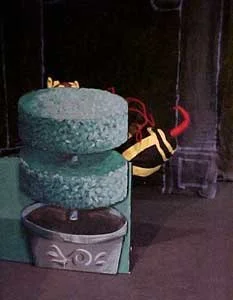
NCTC, 2002: don basilio (matthew bailey, jr.) hides in the garden in Act IV. He is costumed as a bumblebee and could curl the stinger. We were not above cheap laughs.
So, why am I bothered by this one director’s interpretation? And who am I to spout my opinion anyway?
Nearly a quarter of a century ago, twenty years after my Twelfth Night, I translated and directed The Marriage of Figaro at Newnan Community Theatre Company. The libretto became singable, modern English, with everyone’s motives made plain and the jokes pointed up. We approached it as a modern musical comedy, not as a sacred relic (or a penetrating psychological portrait). We sold out three weekends, and audiences laughed at this 18th-century comic opera from beginning to end.
Over and over last night, I kept thinking, “That should have been a laugh.” And it wasn’t. It’s a comedy, people. Make it funny. If a bunch of amateurs in Newnan, GA, can do it, why can’t/don’t the professionals?
